CASE STUDY 03
AI and customer experience
Finding where AI genuinely helps customers and colleagues
AI · SERVICE TRANSFORMATION · INNOVATION


AT A GLANCE
ROLE
Global Associate Director, Service Design and CX Strategy
COMPANY
Kimberly-Clark Professional
SCOPE
Global strategy, pilot in EMEA and UK&I
OUTCOME
17 AI use cases prioritised
The challenge
Like many businesses, Kimberly-Clark had plenty of enthusiasm for AI but no clear view of where it would genuinely help customers and colleagues, rather than just being new.
My role
I shaped priority use cases for Kimberly-Clark’s global data and AI strategy. I also supported the development of a conversational AI agent for our call centre teams through customer and colleague research and insight.
The approach
I identified and prioritised 17 AI use cases across the distributor journey, each tested against real user needs and clear commercial value.

Prioritising AI use cases by customer and business impact
The product team piloted a conversational AI agent supporting call centre colleagues who serve distributors across EMEA and UK&I. Testing revealed something we hadn’t expected: distributors were already using AI tools externally, and they wanted to use them to compare our products with competitors’. They also already felt the pain of our product data often being out of date.
That shaped the design. Rather than presenting every answer as fact, the agent shows its sources and gives each response a trust score, flagging anything it can’t confirm. It helps people navigate imperfect data with confidence today. I analysed the pilot findings and made the decisions on further integration with our external distributor sales tools: what to scale, and where it wasn’t ready yet.

Testing the agent with distributors: every answer shows its sources and a trust score.
Alongside this, I explored how channels such as WhatsApp could integrate with Salesforce to join up the experience.
The trust score helps people work around the problem, but the real fix is the data itself. I identified the core journey capabilities that needed to be in place before AI could scale, and the biggest was product information. I made the business case for a company-wide data transformation programme, which is now under way.
I also lead a product data squad of people from across the business who are tackling related issues, reducing complexity and duplication so that every team, and every AI tool, works from the same trusted information.
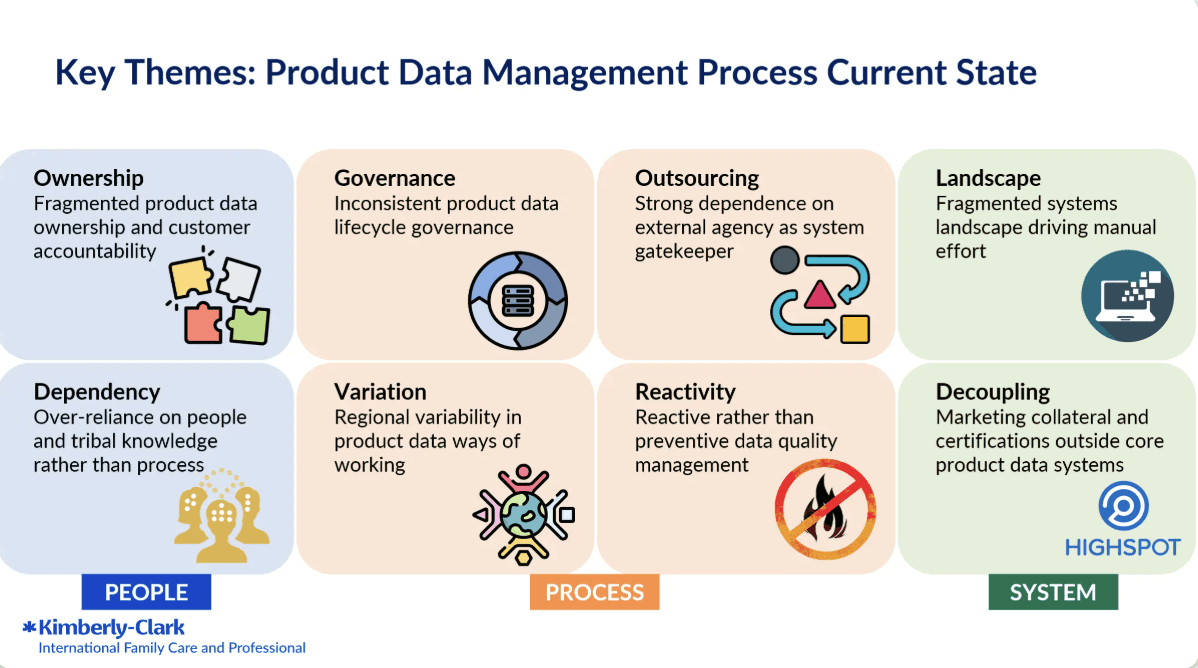
Diagnosing product data across people, process and systems
The outcome
17
AI use cases identified and prioritised
2 regions
conversational AI agent piloted in EMEA and UK&I
1
company-wide data transformation programme, now implemented
The business now has a prioritised AI roadmap for distributors, grounded in customer need, and an evidence-based view of where the agent should scale next. I’m now applying the same thinking to define the customer and AI operating model for Arbex, Kimberly-Clark’s new joint venture with Suzano.
WHAT I’D DO AGAIN

Make sure the right data foundations, owners and governance are in place before planning to scale. AI is only as trustworthy as the data behind it.

NEXT CASE STUDY